Categories
Temperature limiter TUV or SIL2
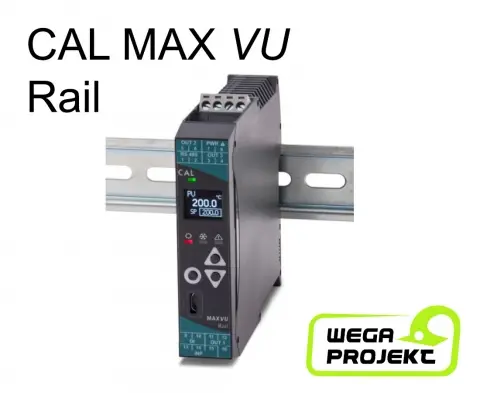
MAXVU RAIL Temperature Limiter
CAL MAXVU RAIL Temperature Controller.
MAXVU Rail temperature and process controller is a behind panel DIN-railmounted device that’s easy to install and fast to setup with an easy to read OLED display.
MAXVU Rail provides an affordable solution where essential temperature controller is required, it offers a universal input and up to 3 outputs. The unit also has a transmitter mode disabling control for temperature and process measurement applications.
Benefits and features of CAL MAXVU RAIL:
- Text / Icon matrix display
- Quick setup menu with main configuration parameters
- Thermocouple, PT100 or linear DC sensor input
- Up to 3 outputs; relay, SSR or Linear DC
- Isolated Digital Input
- High/low, deviation or band alarms
- 3 button operation
- 3 status LEDs
- Front panel configuration or via PC configuration software
- RS485 Modbus RTU communications
Specification:
- Product Category Temperature Controller with Transmitter mode
- Dimensions and size 107mm x 22.5mm x 123mm (HxWxD)
- Input Thermocouple (J,K,C,R,S,T,B,L,N), RTD (3 Wire PT100),
- DC Linear (0 to 20mA, 4 to 20mA, 0 to 50mV, 10 to 50mV, 0 to 5V, 1 to 5V, 0 to 10V, 2 to 10V.)
- Output Relay, SSR, Linear DC
- Number of Outputs 2 or 3
- Weight 0.20kg excluding packaging
- Temperature and RH 0 to 55°C (-20 to 80°C storage), 20% to 95% RH non-condensing
- Power Supply 100 to 240V 50/60Hz +/- 10% (mains powered version)
- 24V DC/AC +10%/-15%, AC 50/60Hz (low voltage version)
- Front Panel Protection IP20
- Certifications CE, UL & cUL
- Compliance Complies with EN61326 (Susceptibility & Emissions) Complies with EN61010-1
- Pollution Degree 2, Installation Category II
- Communications RS485 Modbus RTU communication option
Typical NOs
MVRMVR-1-0-L-AA0-C-5-1-U0
MVRMVR-1-E-M-ZA0-C-5-1-U0
Attachments